Showing posts with label Opel. Show all posts

Sunday, December 5, 2010

Opel Icona Concept Amphibian Hybrid Cars

Opel Icona Concept Amphibian Hybrid Cars
The Opel Icona project was developed in collaboration with Opel by Juan Pablo Bernal at the Umea Institute of Design, Sweden. The concept is a hybrid car that can traverse land and sea is nothing new despite being the stuff of dreams at least half a century ago, but this Opel Icona Concept Amphibian Hybrid Cars takes things to a whole new level.
The Opel Icona Concept is a design study of a futuristic amphibian electric vehicle with a sporty design and retracteable wheels. It can transport an adult and a child.
The project for the Umea Institute of Design 2010 developed at Opel, Germany. This projects aims to create a vehicle that will not only fulfill the expectations of vehicles manufactured today, but go beyond in a range of areas.
By looking at the features of the car and considering the challenges that societies will be facing in 2050, which is the year considered for the project, this paper describes how the vehicle incorporates aspects that will contribute to the solutions required.
The designer has come up with an all-electric concept car, dubbed the Opel Icona, that uses natural sources of energy for propulsion. Running on natural sources of energy, the all-electric vehicle generates power from electric motors to allow a clean and green drive. The zero-emission car would not only allow a sustainable drive but also become a means of entertainment to create a special bond between the family members as well as society.
Designed for the year 2050, the V-shaped car is able to commute on both water and land, opening possibilities to look for alternative locations to reside and experiences to explore. The V shaped dynamic design uses distinctive shapes, forms, patterns and proportions which are express the sporty and leisure-oriented character of the vehicle. The environmentally friendly and energy-efficient vehicle provides a dynamic and practical way to teach children about relevant issues by living experiences that reinforce the family bond.
The concept vehicle features four electric motors that are included in each of the four wheels. The all-terrain vehicle can be driven in two modes – water mode and land mode. When in the land mode, the vehicle is driven using a normal electric drive. However, in water mode, a sail is retracted from the car’s storage area and the wheel arms rotate inboard to reduce drag, thus enabling this vehicle to cruise on water with the same speed and elegance.
About the Designer :
Juan Pablo Bernal is Colombian Designer with a Bachelor in Transportation Design from Instituto Europeo di Design (2003-2006) and a MA Degree in Transportation Design from Umea institute of Design in Sweden.
Among his working experiences are internship at the GM Europe Design and at Scania, Sweden.
Opel Icona Concept Amphibian Hybrid Cars

Friday, December 3, 2010

Opel Amphibian Sport Cars Icona Concept

Opel Amphibian Sport Cars Icona Concept
The Opel Icona Concept Cars is a design study of a futuristic amphibian electric vehicle with a sporty design and retracteable wheels. Keeping such scenario in mind, Swedish designer Juan Pablo Bernal P has designed a futuristic vehicle for the year 2050 that moves on both land and water with equal efficiency. Called the “OPEL ICONA,” the V-shaped commuter vehicle features an aerodynamic body to ensure minimal air resistance for better performance in all conditions. The V shaped dynamic design uses distinctive shapes, forms, patterns and proportions which are express the sporty and leisure-oriented character of the vehicle.
Running on natural sources of energy, the all-electric vehicle generates power from electric motors to allow a clean and green drive. The zero-emission car would not only allow a sustainable drive but also become a means of entertainment to create a special bond between the family members as well as society.
The Opel Amphibian Sport Cars Icona Concept is a hybrid car that can traverse land and sea is nothing new despite being the stuff of dreams at least half a century ago, but this concept cars takes things to a whole new level. It can transport an adult and a child. The Opel Icona project was developed in collaboration with Opel by Juan Pablo Bernal at the Umea Institute of Design, Sweden.
Opel Amphibian Sport Cars Icona Concept
Opel Amphibian Sport Cars Icona Concept features two modes of operation Viz. Land mode and Water Mode to run on ground and water respectively. When the vehicle runs on the ground the sail remains wrapped in the storage area; however, as soon as the occupant puts the vehicle on the water mode the sail retracts and the wheel arms rotate inboard to reduce drag, thus enabling this vehicle to cruise on water with the same speed and elegance.
Opel Amphibian Sport Cars Icona Concept
About the Designer:
Juan Pablo Bernal is Colombian Designer with a Bachelor in Transportation Design from Instituto Europeo di Design (2003-2006) and a MA Degree in Transportation Design from Umea institute of Design in Sweden.
Among his working experiences are internship at the GM Europe Design and at Scania, Sweden.
Opel Amphibian Sport Cars Icona Concept

Thursday, March 4, 2010

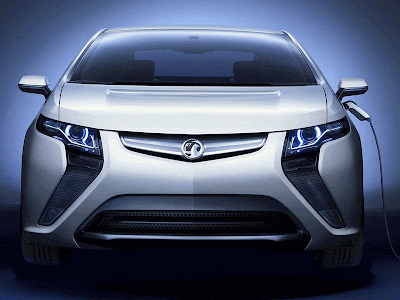
2011 Opel Vauxhall Ampera Plug-in Hybrid

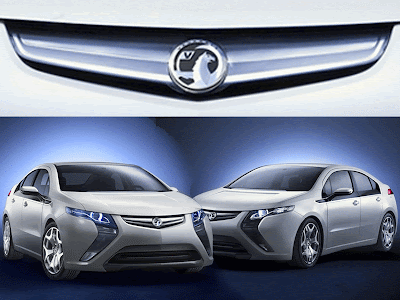
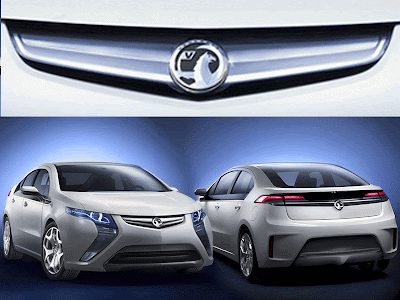
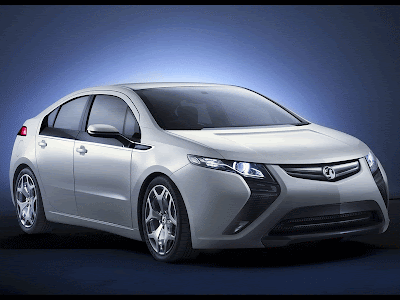
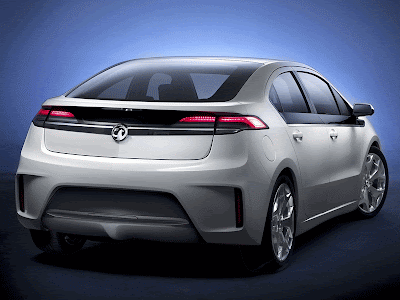
The most enlightening spy photos of the production version of the 2011 Opel Ampera plopped in our inbox today. At first we thought it was just the concept model out testing, but a closer look at the completely undisguised Ampera with the German license plates revealed that this is the actual production model that's due to go on sale in Europe and the UK (as a Vauxhall) in late 2011.
2011 Opel Vauxhall Ampera Plug-in Hybrid
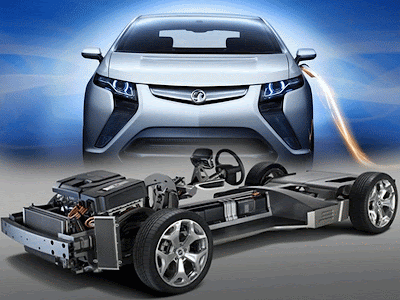
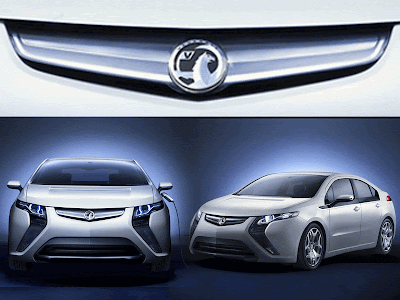
Vauxhall Ampera will be unveiled along with Vauxhall Meriva compact MPV at the Geneva Motor Show 2010. Vauxhall Ampera, schedule for production late next year, is a five-door four-seater with same design DNA as Astra and the Car of the year-winning Insignia. Ampera uses extended-range electric vehicle (E-REV) technology. E-REV uses electricity as its primary power source, supplemented by a small engine to generate electricity for its motors when electric power runs low. This helps the Ampera overcome the ‘range anxiety’ issues associated with pure electric cars.
2011 Opel Vauxhall Ampera Plug-in Hybrid
Unlike other conventional propulsion systems, E-REV uses electricity as its primary power source, supplemented by a small engine to generate electricity for its motors when electric power runs low. This helps the Ampera overcome the ‘range anxiety’ issues associated with pure electric cars. Vauxhall will unveil not one, but two cars at this year’s Geneva Motor Show on March 2, with world premieres of the all-new Meriva compact MPV and a futuristic concept car, which is set to boost the company’s credentials as a leader in environmental vehicles.
2011 Opel Vauxhall Ampera Plug-in Hybrid
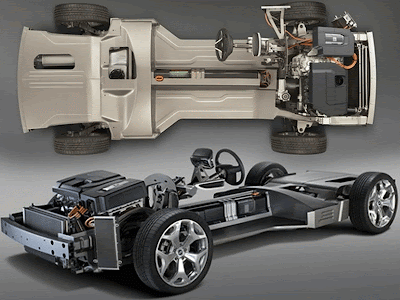
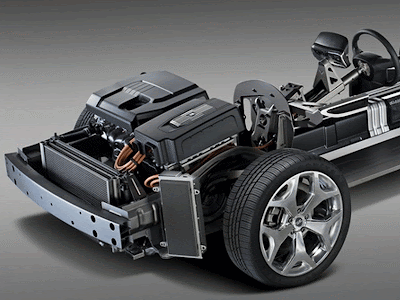
A quick recap of the details we already know, the Ampera will use the same plug-in hybrid gasoline-electric drivetrain as the Volt. It mates a powerful electric motor and a 16-kWh, lithium-ion battery pack to a 75HP 1.4-liter gasoline engine. But unlike conventional hybrids that use gasoline engines to power the wheels when the battery is depleted, the Ampera uses the petrol unit to generate electricity for the electric motor that always drives the (front) wheels. Owners will be able to charge the battery pack with a home outlet and drive for about 64km or 40 miles before the gasoline engine-generator kicks in to extend the Ampera's range to more than to more than 300 miles or 480 kilometers.
2011 Opel Vauxhall Ampera Plug-in Hybrid
Bolstering this message still further at the show will be the groundbreaking Ampera extended-range electric vehicle and Vauxhall’s most economical production car to date, the latest Corsa ecoFLEX.
2011 Opel Vauxhall Ampera Plug-in Hybrid
‘Vauxhall is covering all bases at Geneva,’ said Duncan Aldred, Vauxhall’s Managing Director. ‘With the Meriva, we have a unique and innovative take on family motoring, but the concept car and Ampera prove that we are truly at the forefront of environmental technology. These vehicles also show that their versatility and efficiency doesn’t come at the expense of stunning design.’

Saturday, February 27, 2010

2010 Opel Flextreme GT/E Concept with E-REV Drive System

Think of the Opel Flextreme GT/E concept as a bigger Chevrolet Volt (or Opel Ampera if you're European). The idea behind this concept, which will debut at the Geneva Motor Show (March 4 - 14, 2010), is to show how the Volt's extended-range electric vehicle drivetrain can be used in a larger vehicle, in this case a mid-size five-door hatchback. And it will boost the company's credentials as a leader in green technologies, offering expressive design with efficient environmental performance - and engineered with German precision.
2010 Opel Flextreme GT/E Concept with E-REV Drive System
In Opel's strategy for achieving more independence from fossil fuels, electricity plays a key role. The 4.7-meter long Opel Flextreme GT/E Concept illustrates how extended-range electric vehicle (E-REV) technology can be plugged into large or mid-size vehicles, as well as compact cars such as the upcoming Opel Ampera. Opel calls this strategy e-mobility unlimited: adapting the highly efficient E-REV drive system - which removes the limitations of battery-only power - to vehicles across all market segments. To enjoy zero CO2 driving emissions Opel-style, the Flextreme GT/E concept shows that size doesn't matter.
2010 Opel Flextreme GT/E Concept with E-REV Drive System
The purposeful design also enables the Opel Flextreme GT/E Concept to achieve a projected drag co-efficient of just 0.22, which helps it reach a 200 km/h-plus top speed as well as conserve energy and extend its driving range. Stand-out visual features include a low and wide stance, wing-shaped lights front and rear, a distinctive nose and grille, floating C-pillars and muscular, sculptured bodywork.
2010 Opel Flextreme GT/E Concept with E-REV Drive System
The clean, frontal styling features a low hood line and an extended nose section, which is clasped by wing-shaped, signature LED headlamps. These are deeply carved into the front fenders and across the hood line. The new trapezoidal grille execution is slim but bold. The prominent wing-shaped chrome bar carries a large Opel emblem, which doubles as a socket for charging the Opel Flextreme GT/E Concept's battery pack. The upper section of the grille is used to admit cooling air, the lower portion being covered by a translucent panel. The absence of additional air intakes allows a low frontal area for aerodynamic efficiency and also enables the Opel Flextreme GT/E Concept to meet future pedestrian protection requirements.
2010 Opel Flextreme GT/E Concept with E-REV Drive System
In profile, the Opel Flextreme GT/E Concept is distinguished by innovative, stubbed C-pillars. This floating design allows the glasshouse to be extended rearwards under the arching roofline, emphasizing the flowing lines of the side body. The car's dynamic character is further underlined by a fresh expression of Opel's signature blade motif, now a swooping swage line from the base of the C-pillar into the lower front fender. The translucency of the fixed glass panel in the center of the roof is adaptive, allowing sunlight to warm the interior in the cold of winter, but darkening for coolness in summer. A duct at the rear edge of the roof is for additional cooling of the battery and electronic components.
2010 Opel Flextreme GT/E Concept with E-REV Drive System
Integral to the Opel Flextreme GT/E Concept's expressive looks is the efficiency of the design execution. The small frontal area, low roof height (1308 mm) and a flat, enclosed underbody all enable the car to cleave the air with a minimum of disturbance. The 21-inch alloy wheels are relatively narrow, to reduce wind resistance, and fitted with 195/45, low rolling resistance tires. Clear, flush-mounted trim inserts also minimize air turbulence.
2010 Opel Flextreme GT/E Concept with E-REV Drive System
The Opel Flextreme GT/E Concept also explores the potential for active shape shifting. At speeds above 50 km/h, a vertical panel extends along the body from the air extraction slot behind each rear wheel-arch. These 350 mm-long side spoilers guide high-speed airflow around the rear corners of the car, further reducing the amount of turbulence.
2010 Opel Flextreme GT/E Concept with E-REV Drive System
Mass reduction measures for the body include the use of lightweight, carbon composite outer panels, polycarbonate window glazing and aluminum alloy structural components. Compared to conventional materials, these offer a 40 percent weight saving which further contributes to reduced energy consumption and an increased driving range.
The efficient concept also includes GM's ground-breaking E-REV drive system, already developed for the Opel Ampera. The Opel Flextreme GT/E Concept shows the versatility of this technology by displaying it in a larger, mid-size vehicle format.
2010 Opel Flextreme GT/E Concept with E-REV Drive System
Despite its greater size and a maximum speed of more than 200 kilometers per hour, the Opel Flextreme GT/E Concept is projected to offer performance similar to that of the Ampera: a battery-powered driving range of up to 60 km - with zero CO2 tailpipe emissions - and a total range of more than 500 km. Average fuel consumption is estimated at 1.6 l/100 km, with CO2 emissions of less than 40 g/km. Unlike a hybrid vehicle, the wheels of the Opel Flextreme GT/E Concept are powered at all times by electricity. For typical journeys up to 60 km, energy is supplied by a T-shaped lithium-ion battery pack located under the floor and rear seat.
2010 Opel Flextreme GT/E Concept with E-REV Drive System
However, unlike a battery-only electric vehicle, the Opel Flextreme GT/E Concept eliminates any possibility of range anxiety through fear of being stranded without power. The small gasoline engine/generator is seamlessly engaged to provide electricity whenever the battery's supply becomes depleted. In this mode, the driving range is extended to more than 500 km, until the plug-in battery pack can be recharged or the car is refueled. The motor in the electric drive unit delivers a substantial 370 Nm of instant torque, giving lively performance and projected zero to 100 km/h acceleration in less than nine seconds.
2010 Opel Flextreme GT/E Concept with E-REV Drive System
The Flextreme GT/E concept is a further step in Opel's unfolding strategy for the electrification of the automobile, which includes a wide portfolio of products using battery, extended-range, hybrid and fuel cell technologies.